 KEEP
KEEPThe Zeigarnik effect: why unfinished things stay on your mind
The Zeigarnik effect is the tendency to remember interrupted or unfinished tasks better than completed ones. It is named after the psychologist Bluma Zeigarnik. For anyone with a long list of saved links, it explains why the pile nags you, and why a specific plan can quiet it.
Coming soon to iPhone
What is the Zeigarnik effect?
It is the finding that people recall unfinished tasks better than finished ones. The name comes from Bluma Zeigarnik, a Soviet psychologist who studied the question in the 1920s, as described in Wikipedia's article on the Zeigarnik effect. Her work was linked to her teacher, Kurt Lewin, who had noticed that waiters seemed to remember unpaid orders in detail and forget them once the bill was settled. In the experiments, participants did simple tasks, some of which were interrupted, and were later asked what they remembered.
The popular summary goes further than the studies do. The effect describes better memory for unfinished tasks. It does not prove that unfinished tasks cause constant stress, and later research gave mixed results on how reliable the memory advantage is. Treat it as a useful idea about attention, not as a law.
Why does it matter for saved links?
A saved link is a task you have not finished. You saved the recipe because you meant to cook it, the article because you meant to read it. Each item is an open loop, a small commitment waiting for you. A list of 300 open loops can feel heavy even when you never look at it, which is a common complaint in the research on digital clutter and to-do lists.
That is the connection with the other articles on this site. Why we save things and never do them explains the saving side. The Zeigarnik effect explains why the unfinished pile keeps pulling at attention.
What did the follow-up research find?
A well-known paper by E. J. Masicampo and Roy Baumeister, published in 2011, tested what happens to intrusive thoughts about an unfinished goal. They reported that people who made a specific plan for the goal had fewer such thoughts than those who did not, even though the goal was not yet done. In short, the mind seems to need a plan more than it needs completion.
This matters because it offers a cheaper fix than finishing everything. You do not have to cook the recipe tonight to stop it nagging. You need to decide when and how.
How do I close an open loop without finishing it?
Use the three-part test. For each saved item, you can do one of three things.
Each option converts a vague "should" into a decision. The feeling of an open loop shrinks when a decision exists, even before the work is done.
- Schedule it. Give it a day, a rough time and the first step. "Saturday, 11 am, buy ingredients for the lemon pasta."
- Park it deliberately. Mark it "someday" in a list you review on a fixed date. The loop closes because you have decided to revisit it later.
- Release it. Delete it. This is the most underused option.
What does this look like with a to-do list?
A long, unprioritized list works against the effect. Every line is an open loop. A better list is short and specific, with each item written as the next physical action and a time. The article on turning saved links into a to-do list shows a version of that.
A weekly review matters too. It tells your mind that the list is under control and that nothing is being forgotten. People who skip the review keep re-scanning the list in their head.
How does KEEP apply it?
KEEP is an iPhone app, still in development, whose design follows the same logic without citing the theory. Each save needs a reason, so it is no longer a vague pile. After you choose a reason, KEEP asks whether you actually want to do it. Yes puts it in the Do tab. Someday and the reference option keep the item in Keeps. That second question is a built-in version of schedule, park or release. The Do tab stays short because it holds only commitments.
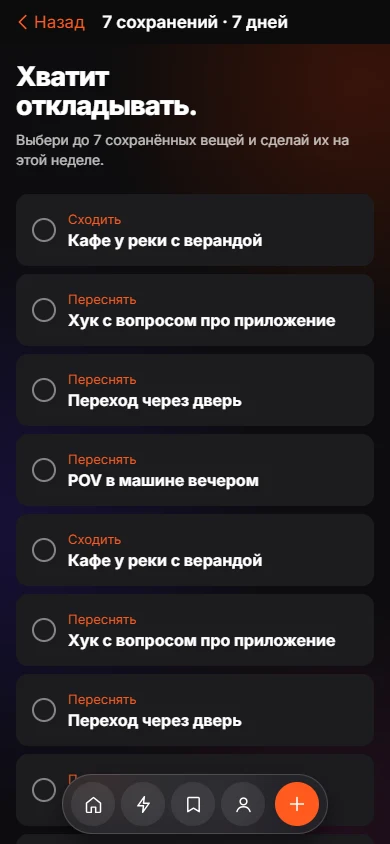
The 7-day challenge pushes the same idea further: pick up to seven saved items and finish them within the week. The Me tab then shows how many of your saves turned into things you did. Read the challenge page for the details, including a caution: the app does not claim a week builds a habit.
Is a notification the answer?
Not by itself. Reminders move the loop from your head to your lock screen. If the reminder says "Check saved posts", it adds a new loop. A good reminder names one concrete task and a time. Keep reminders few, and only for items you have committed to.
What are the limits of this idea?
Three cautions. The effect is a memory finding, not a diagnosis, and it does not explain procrastination on its own. The strength of the effect varies between studies and between people, and some tasks matter more than others. And if constant worry about unfinished things dominates your day, a conversation with a professional is worth more than any list technique.
A practical exercise for ten minutes
Open your saved list and take twenty items. For each, choose one of the three moves: schedule, park or release. Be strict about time and spend about thirty seconds per item. When you finish, count how many fell into each group. Most people release more than they expect. Those released items were open loops that cost attention and returned nothing.
Then look at the scheduled items. Check that each has a day and a first step. If two items compete for the same hour, move one. Close the list and notice how your attention feels. Many people report that a defined list feels lighter than a long unsorted one, even when the number of tasks has not changed.
Frequently asked questions
What is the Zeigarnik effect in simple words?
People tend to remember tasks they started but did not finish better than tasks they completed. Interrupted work stays more present in the mind.
Who discovered the Zeigarnik effect?
Bluma Zeigarnik, a Soviet psychologist, studied it in the 1920s. The idea grew out of observations by her teacher Kurt Lewin.
Does the Zeigarnik effect cause stress?
It describes better memory for unfinished tasks. Whether unfinished tasks cause stress is a separate question, and research on it is mixed.
How can I stop thinking about unfinished tasks?
Make a specific plan for each one: when, where and the first step. Research by Masicampo and Baumeister suggests a plan reduces intrusive thoughts about an unfinished goal.
Does the Zeigarnik effect apply to saved links?
It is a good lens for them. A saved item is an unfinished intention, so a large unsorted list can keep pulling at attention until you decide what to do with each item.
Keep exploring
 The 7-Day Challenge and Monthly Recap in KEEPPick up to seven saves, do them in a week, see what became real.