 KEEP
KEEPWhy we save things and never do them
We save things we never do because saving costs one tap and gives a small feeling of progress, while doing needs time, a plan and a decision. Without a reason attached, a saved item has no trigger. Attach one verb at the moment of saving and review weekly.
Coming soon to iPhone

Why is saving so easy and doing so hard?
A save takes a second and carries no commitment. A task needs time, people and a place. The brain scores both as a step toward the goal, but only one moves you. This is a known pattern in the study of digital hoarding: collecting digital items you never use.
Does an unfinished item stay in your head?
Psychologists describe the Zeigarnik effect: people tend to remember interrupted or unfinished tasks better than finished ones. In the original 1927 work Bluma Zeigarnik studied this with simple tasks. A big pile of saved intentions can keep tugging at you without telling you what to do. Later research on the effect has been mixed, so treat it as a useful picture and not a law.
What helps?
One tool with decent evidence is the implementation intention, a plan of the form "if situation X occurs, I will do Y", introduced by Peter Gollwitzer. It turns a vague wish into a trigger. You can apply it to saved items: "If I have 15 minutes on Saturday, I will cook the pasta I saved".
- Attach one verb to each save when you save it.
- Say the situation: when, where or with whom.
- Review a short list weekly and do one thing.
- Delete what stays untouched for months.
How does KEEP apply this?
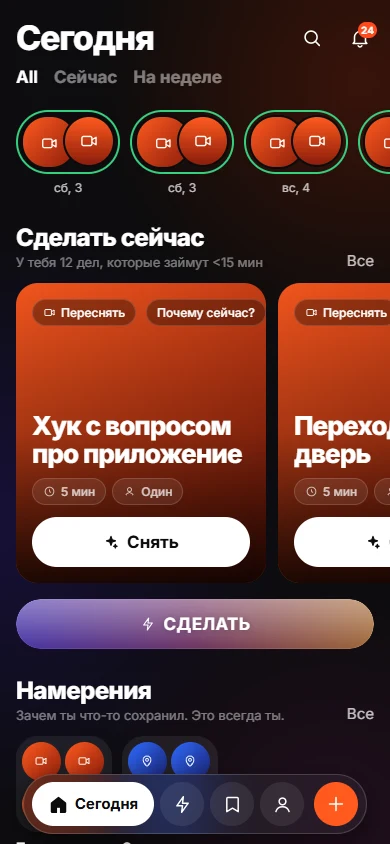
KEEP records the verb as one of eight intents and lets you add who, where and when. Today and Do show items that fit your current time, and every card says why. The app does not decide the verb for you, since a guess about your motive would often be wrong. See save with a reason.
Does more saving make it worse?
More saving makes the pile bigger and the next step less visible. KEEP's monthly recap shows how many things became real first and how many you saved second, so the number you see rewards doing. See the 7-day challenge.
What if I never want to do most of it?
That is information. Let those items go. A small, honest list is easier to trust than a large one that you avoid.
A short experiment you can run this week
Open your saved list and pick ten items at random. For each, write one verb and one situation, or delete it. Count how many survive. Expect some to go away immediately, because the motive is gone. The ones that stay are the real list.
Then do one of them within 48 hours. You are testing whether a verb and a situation are enough to start. If they are, you do not need a bigger system.
What this does not claim
No app removes the effort of doing. A good system lowers the cost of starting: it picks a small task, names the situation and removes the search for the link. The effort of cooking, visiting or filming stays with you, and the satisfaction does too.
Frequently asked questions
Why do I save posts and never look again?
Saving is cheap and gives a feeling of progress, while doing needs time and a decision. Without a reason and a trigger the item has nothing to bring it back.
Is saving things bad?
No. It becomes a problem when the pile grows and you stop trusting it. Keep a short list with reasons.
What is an implementation intention?
A plan in the form "if X happens, I will do Y". Peter Gollwitzer described it, and it links an action to a situation.
How many saves should I keep?
There is no research number to cite here. A practical test: could you do one of them this week? If not, shorten the list.
Keep exploring
 How to Turn Saved Links Into a To-Do List You UseGive each link a verb, minutes and a situation, then work from a short list.
 How to Organize Saved Instagram Posts So You Use ThemCollections help you find posts. A reason and a weekly review help you use them.
 The 7-Day Challenge and Monthly Recap in KEEPPick up to seven saves, do them in a week, see what became real.